
India's Textiles Minister Shankersinh Vaghela Thursday stressed the need for Asian countries to come together to enhance competitiveness and harness their advantages to withstand global competition.

Abolition of customs duty and special additional duty on man-made fibres as it would help the industry to source fibres from global markets during the time of shortage or a sharp increase in domestic prices.

Designer Archana Jaju's brand is focused on bringing India's fine craftmanship into everyday clothing.

The Cabinet on Wednesday approved the production-linked incentive (PLI) scheme worth Rs 10,683 crore for textiles sector with an aim to boost domestic manufacturing and exports. The decision was taken in a meeting which was chaired by Prime Minister Narendra Modi. The Cabinet "has approved the PLI scheme for textiles for MMF (man-made fibre) apparel, MMF fabrics and ten segments/ products of technical textiles with a budgetary outlay of Rs 10,683 crore," Textiles Minister Piyush Goyal told reporters.

In a move that could improve the weakening sentiment in the Indian textile industry, the government is set to sign a free trade agreement (FTA) with the European Union (EU) by the end of the current calendar year.
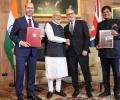
India and the UK on Thursday inked a landmark free trade agreement (FTA) that will cut tariffs on British whisky, cars and an array of items, besides boosting bilateral trade by around $34 billion annually.
A decline in exports, which is a distinct possibility at the moment, would affect employment in the sector and even lead to a loss of existing jobs.

State governments have requested the Centre for export incentives, lifting of import duty in the case of cotton for the textile sector and GST exemptions.

Various industry bodies have sought immediate government intervention through the imposition of anti-dumping duties, claiming India has seen a surge in imports of Chinese goods over the past two weeks.

Despite the recent Western criticism on Bangladesh's labour standards, India has a long way to go before it overtakes the neighbour in global exports.

On the table are additional batches of S-400 surface-to-air missile systems from Russia, which India used with immense success during Operation Sindoor. India could buy at least two squadrons of Su-57 fighter jets plus joint production of S-500 air defence systems.
The Indian textile industry, hit hard by recession in the United States and the European Union, said a steep 20 per cent rupee depreciation and the Rs 1,400-crore (Rs 14 billion) package has not helped in boosting sagging exports and demanded that the government should do more to help it come out of the woods.
The rupee's 11% gain against the dollar has driven U.S. and European retailers to switch their orders to countries with weaker currencies.

When Chennai-based Wedding Designer Ambika Gupta first received a brief for a destination wedding in Udaipur, she had no idea it would turn into one of the most high-profile celebrations of the season.

Backed by the China-plus-one policy, India's textile and apparel exports have seen a 53 per cent growth during the April-November period of the current fiscal year at around $26 billion. This compares to the figure of $17 billion during the same period in FY21. According to Wazir Textile Index, all major companies including Welspun, Vardhman, Trident, KPR Mills, Indo Count, RSWM, Filatex, Nahar Spg and Indorama have posted higher sales during the first half of the current fiscal year compared to the pre-pandemic year.

India and the US have concluded the fifth round of talks for the proposed bilateral trade agreement (BTA) in Washington. Both sides are looking at finalising an interim trade deal before August 1. Issues related to agriculture and automobiles figured during the negotiations.

If the Thackerays don't save a Marathi school in their backyard, who will, wonders Syed Firdaus Ashraf.
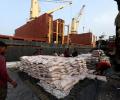
Apex exporters body FIEO on Tuesday expressed serious concerns over high US tariffs on Indian goods and said that textiles and apparel manufacturers in Tirupur, Noida, and Surat have halted production amid worsening cost competitiveness due to these steep duties. The US duties on Indian goods will increase to 50 per cent from August 27.

'High taxes have kept away art collectors who will now embrace the new GST.'

The USA's steep 50 per cent tariffs on Indian goods entering America will severely impact exports and job creation in labour-intensive export sectors such as shrimp, apparel, leather and gems and jewellery. Exporters said that the imposition of a 25 per cent penalty on India over and above the 25 per cent tariffs move will disrupt the flow of Indian goods to its largest export market.

'This is an area where good lending can happen, and that is one of the priorities for the next quarter.'

Communication channels between India and the US are open to resolve the ongoing tariff issues, and the glitch in trade ties is only temporary, given the long-term relationship between the two nations, government sources said on Wednesday. The US' 50 per cent tariffs on Indian exports to America came into effect from August 27, barring a few sectors.

An Indian commerce ministry team will soon visit Washington for another round of talks on the proposed trade agreement with the US to iron out differences in sectors, like agriculture and automobiles, a government official said on Thursday.

Equity benchmark indices Sensex and Nifty fell on Friday, extending their downward journey to the third day, as investors continued to reel under pressure caused by the imposition of high tariffs and relentless foreign fund outflows.

On his 200th birth anniversary, Utkarsh Mishra traces the life, thought, and legacy of Dadabhai Naoroji, the Grand Old Man of India.

The United States action of levying 25 per cent additional tariff on Indian goods is 'unfair, unjustified and unreasonable', India said on Wednesday in a firm reaction, signalling increasing tensions between the two strategic partners over New Delhi's energy ties with Moscow.

On August 7, the US president announced doubling tariffs on Indian goods to 50 percent for India's purchases of Russian crude oil, but gave a 21-day window to negotiate an agreement.

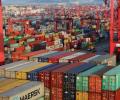
Imposition of high tariffs on China, Mexico, and Canada by the US is expected to help Indian exporters in increasing their shipments to the American market, experts say.
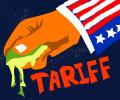
US President Donald Trump on Wednesday slapped an additional 25 per cent tariff on goods coming from India as penalty for New Delhi's continued buying of Russian oil.
The trade relationship between India and the United States has been strained by the imposition of 25% tariff by the US on Indian goods.

Hectic parleys are underway between officials of India and the US in Washington on the proposed interim trade agreement between the two countries, an official said on Wednesday.

The $1.2 billion in-space manufacturing market is expected to grow and be worth more than $20 billion by 2033.

Reliance Industries' refining earnings will remain steady, supported by its position as India's largest importer of Russian crude and favourable global supplies, according to analysts at JM Financial and Goldman Sachs. Reliance imported more Russian barrels than any other Indian refiner in the past eight months, according to data from Bloomberg/Kpler.

The Bloomberg report suggests that this backchannel communication from President Xi has laid the groundwork for a broader thaw in relations. This overture has since translated into a series of tangible diplomatic actions leading up to the upcoming Shanghai Cooperation Organisation (SCO) summit.

Car restoration service provider Super Car Club Garage (SCCG), backed by Raymond chairman and managing director Gautam Singhania, has sought the Centre's green light for a licence to import foreign vehicles for restoration and subsequent re-export.

Among Sensex firms, Tech Mahindra, HCL Tech, Eternal, Axis Bank, Maruti, Tata Steel, HDFC Bank and Asian Paints were the gainers. However, Adani Ports, Trent, Tata Motors, Hindustan Unilever and NTPC were among the laggards.

'India did not surrender. That was why he wanted to pressurise India by this 25% tariffs.'

Goods from sectors, including agriculture, precious stones, chemicals, pharma, medical devices, electricals, and machinery may get impacted if the US will go ahead with imposing reciprocal tariffs on Indian products, according to experts. They said that these sectors could face additional customs duties from the Trump administration because of the high tariff differential or gap, which is the difference between the import duties imposed by the US and India on a product.
 © 2026 Rediff.com - Advertise with us - Disclaimer - Privacy Policy - Sitemap - Feedback - About us - Terms of use - Grievances